
Prelude to Foundation by Isaac Asimov
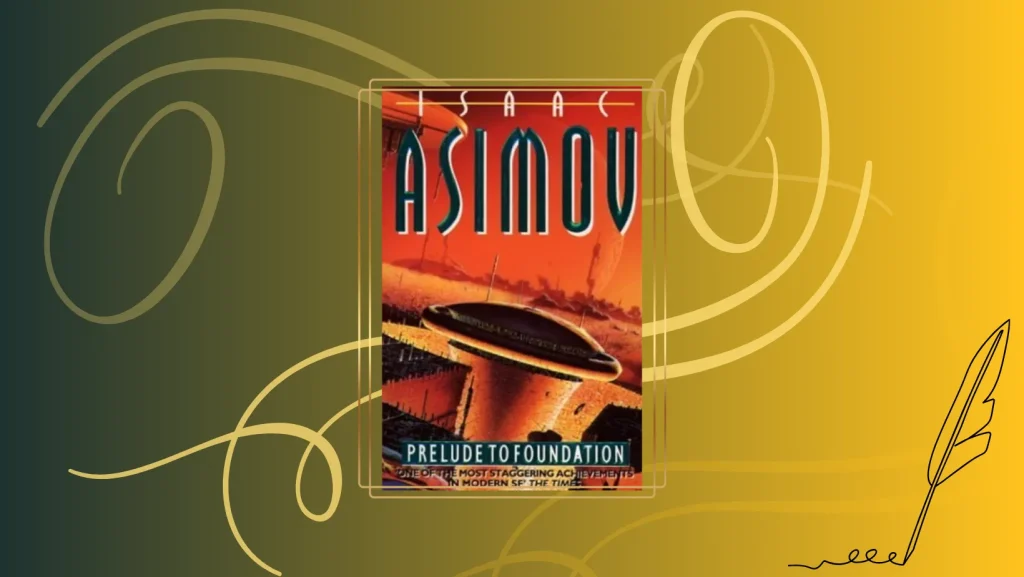
Whispers of the Story
Imagine that you present a paper at a mathematics convention showing that it might be possible for mathematics to predict the future. It’s a theoretical idea that might never be proven. But the most powerful man in the Empire believes that you already know what will happen to his reign.
One idea, one misinterpretation, one lie, and Hari Seldon goes into the depths of Trantor and discovers many secrets. All the new information gathered leads him to believe that his theory might actually become a new field in science psychohistory. Can he use the information from the past to predict the future?
Review of Prelude to Foundation by Isaac Asimov
After the bitter taste left by the last novel of the series, Foundation and Earth, where I was disappointed by the plot and the characters, Prelude to Foundation came like a breath of fresh air. It has intrigues, cliffhangers, politics, and so many twists that it kept me hooked from the beginning till the end.
Hari Seldon, a young mathematician with an idea, is the main character here. If we were used to the almighty, all knowing Hari Seldon who predicted that the Empire would fall into Dark Ages, or the hologram of Hari Seldon who appeared every time the Foundation faced a crisis, this time we have Hari the man before the legend. He has an idea that psychology and history combined with mathematics will be able to predict the future. But this concept is so new in his head that he doesn’t believe it is actually possible. The twist of fate? Everyone believes he already knows the future but refuses to tell.
Hari Before He Was a Legend
Hari meets a man who claims that Demerzel, the First Minister, is planning to take him, so he is forced to flee, hide, and try to make psychohistory a real thing. We get not only descriptions of the many sectors of Trantor, political intrigues, and social disparities, but also stories about the past, humanity, and the first Earth. Trantor, with its many sectors, is like the Empire on a smaller scale. Its history, divisions, and development become the foundation of psychohistory itself.
Hari is not just an observer. He is a man of action, fleeing from danger, sneaking into forbidden places, and barely escaping death. It’s so refreshing to see Hari as a younger man, full of life, at the very beginning of the path that will lead to psychohistory. This is Hari before the weight of the galaxy rested on his shoulders. This is Hari discovering, learning, making mistakes, and growing.
The Twists That Made Me Go “What the Hell?”
But Asimov went the extra mile in Prelude to Foundation, and honestly, I loved him for it. Hari is kidnapped. There is a plot to overtake the Empire. And the man helping Hari hide from Demerzel? It’s Demerzel himself, who carefully guided Hari through all the troubles so he would actually develop psychohistory. And Demerzel is a robot from Earth.
Not only that, but the woman who helped Hari along the way is also a robot. And he marries her. By the end of the novel I went through so many emotions and so much turmoil that I was left with just a “what the frak?” moment in the best possible way.
What Made This Work
I think you can tell by my writing how excited I was to read this book. It has everything I love about the Foundation series: intrigues, politics, plot twists, human emotions, internal monologues, character development, and it shows the dark side of human societies. This is the Foundation I fell in love with. This is the Asimov who knows how to weave a compelling narrative where every piece matters and every character has depth.
The pacing is brilliant. The revelations are perfectly timed. The characters actually feel like people rather than cardboard cutouts moving through a philosophical treatise. Hari’s journey from naive mathematician to the man who will save civilisation is believable because we see him learn, struggle, and adapt.
Final Thoughts
I totally recommend this book to fans of the Foundation series and sci fi in general because it sets the tone and explains many things in the series. If you were disappointed by Foundation and Earth like I was, this will restore your faith. If you’re new to Foundation, this is actually a brilliant place to start because it gives you Hari’s origin story and makes you care about what happens to him and his vision.
This is Asimov at his best. This is why I love the Foundation series. This is what was missing from Foundation and Earth. If you only read one more Foundation book after the original trilogy, make it this one.
Rating: 8 out of 10. A return to form that reminds you why Foundation is a masterpiece.
Happy reading!
It’s your turn! If you liked my thoughts on this book, please consider following and contacting me so we can talk about it.


