
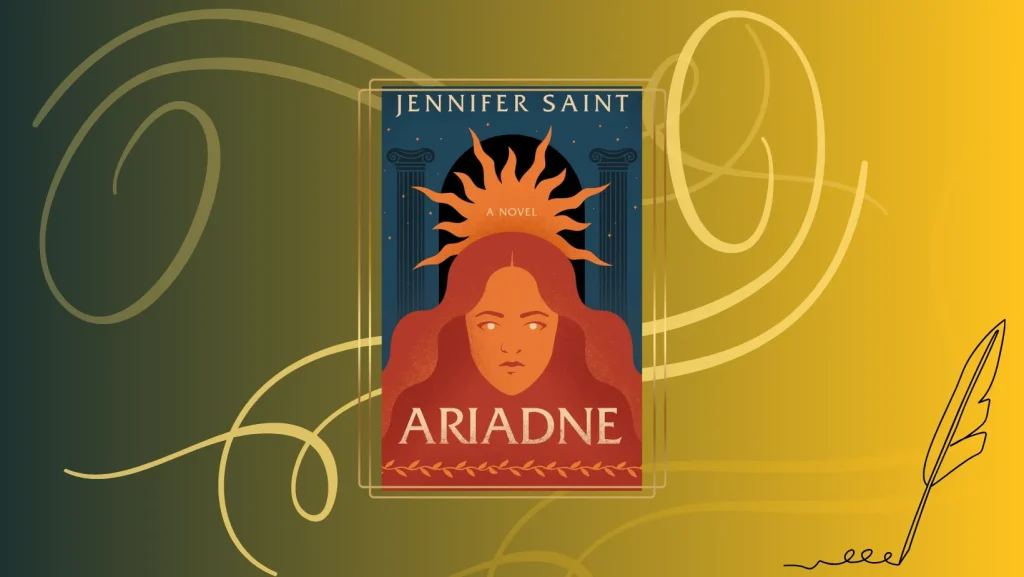
Ariadne by Jennifer Saint
Whispers of the Story
Ariadne grows up hearing stories of gods and heroes, honour, courage, and women who are used then left behind. When her father, King of Crete, Minos, presents her to the man who will be her husband, she decides she will not be like the women in her stories. She will choose her own life.
Ariadne falls in love with a young prince, Theseus, helps him kill her brother, and runs away with him to a new life. But when she wakes up abandoned on a small island, she realises she became exactly like the women in the stories: used and kicked aside.
Ariadne is not the only princess of Crete that falls in love with Theseus. Phaedra, Ariadne’s young sister, actually gets the prince for herself. But soon she’s disappointed by him in a different way.
Will the two sisters survive the disappointments of men? Well, it’s a Greek tragedy, so of course the women do not survive.
Review of Ariadne by Jennifer Saint
Jennifer Saint brings to life a woman from obscure Ancient Greece to the 21st century. Actually two, since the novel depicts the destinies of both princesses of Crete, Ariadne and Phaedra, despite the title. Both of their stories start the same, with falling in love with Theseus and then being disappointed by him. But as time goes by, Ariadne becomes a woman who just accepts her life without question, like a leaf in the wind of the fates, whilst Phaedra takes control of her life. Both of them fall in love again with men who seem perfect until they’re not. In the end, both of them die because of the men they loved.
We all know the myth, right? Ariadne helps Theseus kill her brother, the Minotaur, free his people, and leave Crete. Like many men in the ancient myths, he only used her and pretended to be in love with her until he got what he wanted, then left her on a small island. If you’re expecting to see Ariadne as a strong woman, misunderstood by time and much more complex than just a pretty face, then you’re going to be disappointed.
Ariadne: The Passenger in Her Own Story
I read Circe by Madeline Miller and I absolutely loved it. Circe is portrayed as a strong woman who went through different stages of womanhood. She made mistakes, she fought, and she discovered the most important things in life. But Ariadne? She’s exactly the woman from the myths.
She decides not to become like the women in the stories who are used and left by men, so she takes life into her own hands, plots, lies, and helps a beautiful man, only to be used by him. And what does she do afterwards? Lives her life with Dionysus just as it is, a simple woman who doesn’t question the world around her. She becomes like a side character in her own story.
Of course by the time she sees the truth in her small world, what her husband has become, she only sees the cruel side of him, but not the journey that got him there. For a woman who was abandoned by a man, she trusts the next man in her life too much, especially one who has lots of women worshipping him.
By the time Ariadne wakes up from her dream state and realises what her husband is doing, she’s appalled. Really? She’s grown up in a court where people were given as food for the Minotaur to hunt and eat. She lives in a world where people are killed in the most gruesome ways and people sacrifice animals to the gods. The fact that her husband can actually bring back the sacrificed animal is too much for her? I think Jennifer Saint just wanted to give Ariadne some depth in thinking and some moral compass, but it just feels shallow.
There are only three moments when Ariadne is a woman of action. First when she helps Theseus, which costs the death of her brother, the ruin of her and her sister’s life, and in a chain reaction, her father disappears. The second time is after the visit from her sister, whom she never tried to find. She goes to her (the first time she even thinks of leaving the island, before that the thought never crossed her mind, so she was a prisoner of her own volition) and does nothing. Ariadne tells her sister again that she’s mistaken, has a weird reunion with Theseus, and fails to save her life. The third time Ariadne took action was when she died. Ariadne is the definition of a passive woman.
For me, Ariadne lacks depth, is shallow, has morals only when it suits her, and barely thinks of the implications of her actions and lack of actions. I know that the myths don’t allow much room to create a powerful woman, but on the island she should have been a queen in action, not only in name. I would have expected her to pull some strings with the people that visit the island, to try to find out about her sister and help her, and also help other women in need. Dionysus brings women who were wronged by men to that island, and they help each other, but Ariadne does nothing for them. For this reason, I was looking forward to the chapters dedicated to her sister, because at some point Ariadne’s story had no action, and her monologues were so boring.
Phaedra: The Queen Who Actually Reigned
Phaedra is something different altogether. She falls in love with a man, when she gets to be alongside him she falls into depression, and by the time she actually marries him she’s enraged. In all fairness, Theseus is a shallow man, but I’ll get to him later. But Phaedra forges a place for herself and manages to actually get some power. Which is impressive, considering she lives in a world dominated by men, and not only is she a woman, she’s a foreigner.
Unlike Ariadne, Phaedra never stopped thinking about her sister. Ariadne’s disappearance shocked her so much that she could not be happy in her marriage because she suspected her husband was responsible. Well, she was right. When she found out where her sister was, she immediately went to her. Hoping for Ariadne to understand her and give the advice she wanted to hear, she tells her life story. And there it was, in that moment we find out the big secret, Phaedra’s damnation. That reveal was the best part of the book.
Phaedra, the queen, the woman with the most influence, the manipulator of men, de facto ruler of Athens, falls in love like a teenager with her husband’s son, Hippolytus. And that love becomes an obsession that convinces Phaedra that the love is mutual. Seriously, the smartest woman in Athens who manipulates her husband as she pleases doesn’t see that the young man who wants to call her “mother” feels nothing for her?
Like in any Greek tragedy, disaster strikes when she declares her love for him. She dies, he dies, and tragedy affects the whole family.
Phaedra’s story is the reason I give this novel such a high rating. It was intense, I could see her reasoning and adored her climb to power and loved the tragedy of a woman in love. Her personality remained consistent from the beginning till the end. She was strong, capable, but just as she was very rational, she was also very spiritual. And that was her downfall. Also, she fell in love with Theseus as a teenager and then as a mature woman she fell in love with Theseus’s teenage son. I would say she definitely has a type.
Men: Where Are You? Because All I See Are Cardboard Cutouts
Now let’s talk about the men in the novel. I think their portrayal is the reason why some call this novel feminist. Not because the two female main characters are role models, or important, or even good (I’m referring to Ariadne). Because the men are depicted like shallow idiots who only care about having a woman in bed and a drink in hand. This is not feminism, by the way.
Theseus is a pretty boy and that’s it. He seeks glory and fame and that’s it. He doesn’t care about the women he leaves behind, he doesn’t care about ruling his kingdom, and he doesn’t care about potential children he leaves behind. He likes to fight, hunt, and conquer women, but after he has them he moves on. What the hell? I agree that the Theseus from the myths is not the strong, good, kind, moral, and just Theseus from recent films, but don’t transform him into a superficial Ken doll.
Dionysus was like a hero from a fairytale at the beginning. He falls in love with the young woman on his island, tells her his story, and in the end marries her, giving her the life she only dreams of. But he’s a god. Unlike other members of his celestial family, he’s good, kind, and doesn’t want to hurt mortals just for fun. But he is also shallow, wanting and expecting for the women around him to worship him.
In the last part of the novel, he’s the man who just pretends to be kind. In fact, for some reason Dionysus hides a whole new personality from his wife. He also becomes just as vengeful and sadistic as his father and brothers. For me, it felt like he was one character at the beginning of the book and another at the end.
The Final Verdict
Overall, I cannot say I didn’t like the book. I did, for the most part. But I started reading it thinking it was similar to Circe by Madeline Miller, and I was disappointed by the portrayal of Ariadne. I was also disappointed by the description of the men in the book, like they have no substance or relevance whatsoever. I understand they’re side characters, but it feels degrading.
The story moved slowly at some points. When Ariadne found herself alone on the island, the story was dragged, maybe to build some suspense for the arrival of Dionysus. His arrival and them falling in love was shallow as well. The whole novel feels like a build up for the main moment, which feels like it’s the death of both sisters.
If you’re looking for a Greek mythology retelling with a powerful female protagonist like Circe, this might disappoint you. Ariadne is frustratingly passive, though Phaedra’s story saves the novel from being completely forgettable. The tragedy is there, the setting is beautifully rendered, but the characters lack the depth I was craving.
Read my review of Circe by Madeline Miller to see why I loved that book so much. Let me know your thoughts on this novel as well. Do you think the two novels are similar and I’m being too harsh, or do you feel as well that this book is lacking something?
Rating: 7 out of 10. Phaedra’s thread in this story is golden, but Ariadne’s is frayed and disappointing.
Happy reading!
It’s your turn! If you liked my thoughts on this book, please consider following and contacting me so we can talk about it.


