
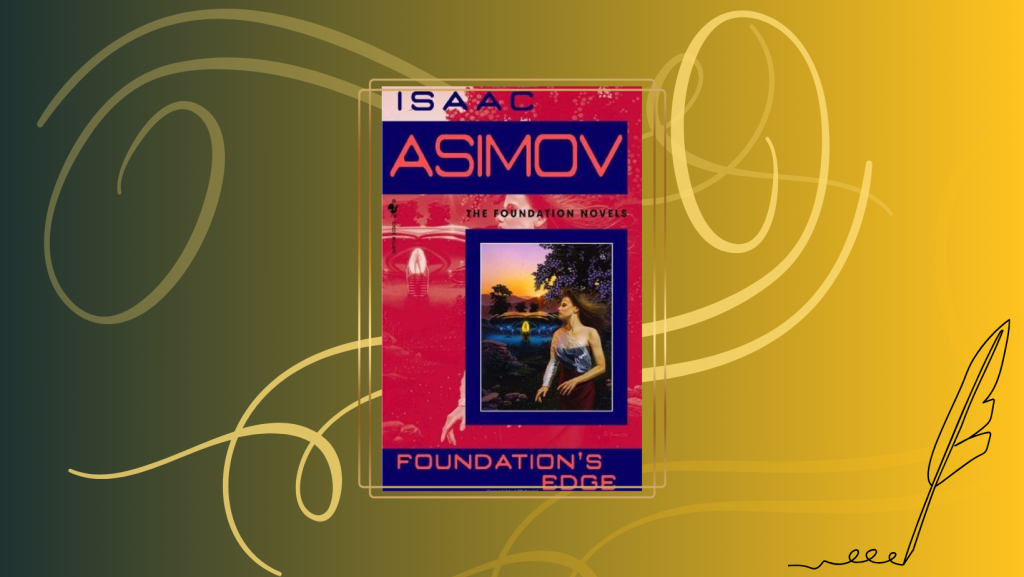
Foundation's Edge by Isaac Asimov
Whispers of the Story
Five hundred years after the Foundation was founded the idea that The Second Foundation is still pulling the strings lingers. Two men are sent on a voyage to find it in secret, while appearing to be looking for Earth.
While both the Foundation and the Second Foundation are looking for them, they uncover one of humanity’s oldest and most closely guarded secrets: what happened on Earth. Just a little spoiler: someone else had been pulling the strings all along.
Review of Foundation’s Edge by Isaac Asimov
Foundation’s Edge was written nearly 30 years after the series’ third novel, and it shows. If the first three novels in the series were relatively simple, this novel is far more complex, with many new revolutionary technologies and ideas. Obviously, he used the newfound knowledge of technological development in his books.
The storyline and characters remain simple, as they were in the first novels of the series. Trevize is a moral man who strives to do the right thing and has really good instincts. Pelorat is a classical professor who is only interested in one subject, so he is completely unaware of the politics and schemes going on around him. He is like a very old man whom you must protect. Gendibal is a powerful man with a brilliant deductive mind, and not just because he can manipulate others. I can’t decide between Trevize and Gendibal as my favorites. I liked how all of the characters were described in very simple terms, with only the necessary abilities for the action in the book and no information about their backgrounds. In contrast to the current trend of describing many past events to justify current behaviours and aspects of personalities, this was like a breath of fresh air.
The action development was superbly executed. The novel begins with a problem being settled and the main character going into exile. For the first time since the introduction of the Second Foundation, the storyline depicts them as having a problem, with only one man seeing the truth and offering a solution, a storyline that was typically reserved for the first foundation in previous novels.
Representatives from both foundations are brought together at Gaia. As they decide to start a measuring contest, they actually remain in the background as the larger story unfolds. Foundation believes they are in control. The Second Foundation believes they still have control. But the truth is that both of the foundations were manipulated by another more powerful entity who had control all along. It is difficult to establish exactly what kind of entity we are talking about, hinting of a higher power omnipotent and omnipresent such a God, but with no clear label. As a result this part was much more philosophical and I admit I barely understood it, but I didn’t dwell too much on trying to understand it completely.
Again, the future rests in the hands of one man, chosen for his capacity to understand the situation, just like in the first novels. Trevize’s choice was obvious, the story had to remain open, and truly nothing changed.
There was also the concept of robots on Earth, which was clearly a reference to his other popular series, I, Robot. I haven’t read it yet, but I’ve heard nothing but positive things about it, so it might be worth starting.
If you want a sneak peak on the Foundation’s origins you can read my review of the first novel in the series, Foundation.
Happy reading!
It’s your turn! If you liked my thoughts on this book, please consider following and contacting me so we can talk about it.


